Plastic Pallets for Food & Logistics
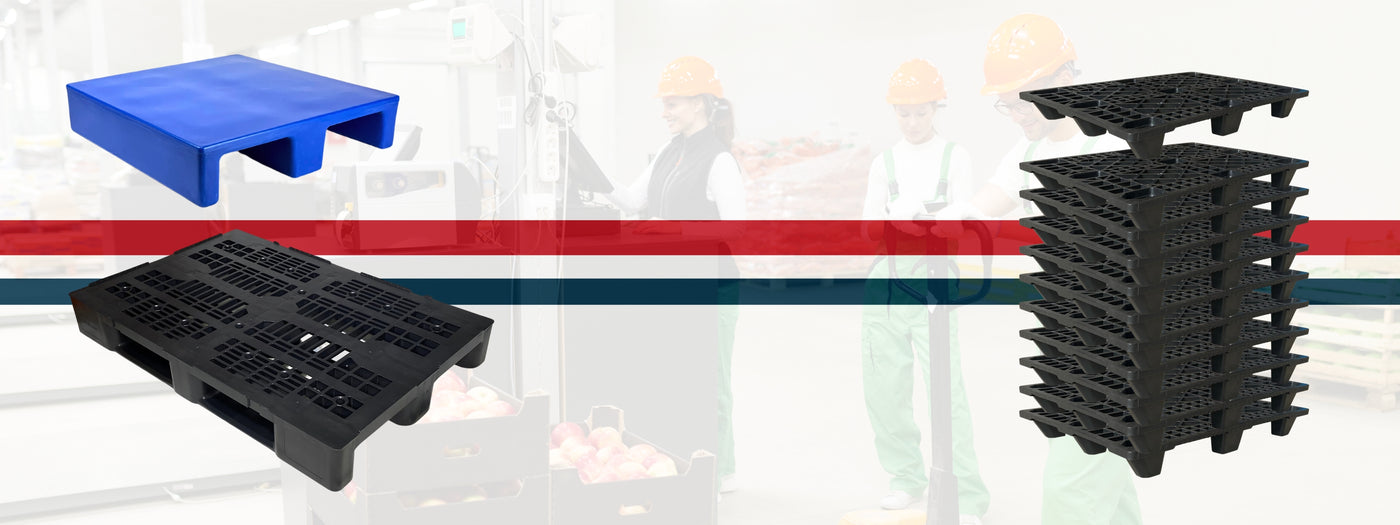
Fletcher manufactures and supplies plastic pallets in three footprints - 1200 x 1000mm, 1200 x 800mm and a 600 x 600mm compact format - with static load ratings from 250kg to 5,000kg. Seven pallets in this range are moulded from recycled plastic.
All of them wipe clean, will not absorb moisture or splinter the way timber does, and sit outside the scope of ISPM 15, so there is no heat treatment or IPPC stamp to manage when a load leaves the country. Which pallet you need comes down to two things: how much weight it carries, and how it is handled once it is loaded.
Industrial and export pallets
The same pallets that work on a food production floor are built for general industrial use: warehousing, manufacturing, automotive and chemical sites, cold stores and freezers, and anywhere timber pallets break, splinter or shed debris. The heavy duty five-runner pallets carry up to 5,000kg static and 1,250kg in racking, and none of the range absorbs moisture, so they hold their ratings in chilled and freezer storage where timber swells. For export and international shipping, plastic pallets need no ISPM 15 heat treatment or IPPC stamp, and the nestable lightweight range keeps the cost down on one-way loads.
Nestable lightweight pallets
The cheapest route off timber for one-way shipments and high-volume internal movement. Four options at 1200 x 800mm and 1200 x 1000mm, 130 to 135mm tall, carrying static loads of 1,500kg to 2,000kg and dynamic loads of 700kg to 1,000kg. All four are moulded from recycled plastic.
Open deck versions are the lightest and cheapest. Closed deck versions cost a few pounds more and give you a flat top surface with fewer dirt traps, which is what you want in clean areas, dry goods zones and dispatch. Because they nest rather than stack, a column of empties takes a fraction of the return-trip volume of the same number of timber pallets, which is where the cost comes back on a two-way route.
None of the nestable pallets carries a racking rating. If the load is going into a beam rack, use a medium or heavy duty pallet, or look at plastic racking built to take the load directly.
Medium duty Euro pallets
The Euro Plastic Pallet is an open deck unit at 1200 x 800mm and 150mm tall, rated 4,000kg static, 1,000kg dynamic and 400kg in racking, moulded from recycled plastic.
1200 x 800mm is the true Euro footprint, so it drops straight into European pallet racking and matches the base dimensions of standard Euro stacking containers. It sits between the nestable range and the five-runner heavy duty pallets: rackable, which the lightweight pallets are not, but lighter and cheaper than a full heavy duty unit.
Heavy duty and hygienic pallets
Five pallets built for repeat-trip use in racking, on conveyors and in wash-down environments.
The strongest is the solid deck five-runner at 1200 x 1000 x 160mm: 5,000kg static, 2,500kg dynamic and 1,250kg in racking. It comes in blue, red, green and yellow, so it drops into an existing colour-coded scheme for allergen control or production zoning, and there is a recycled version carrying the identical load ratings at a lower price.
The food grade pallets use an open deck rated 4,000kg static, 1,250kg dynamic and 850kg in racking, and are stocked in both the 1200 x 1000mm GB footprint and the 1200 x 800mm Euro footprint. Open deck construction drains and dries faster after wash-down; a solid deck contains spillage and gives a continuous surface under an unstable load. For bulk product rather than palletised cases, see plastic pallet boxes, and for the cases themselves, stack and nest containers.
Compact and display pallets
The Minipal is a 600 x 600 x 150mm solid deck pallet rated to 250kg static, available in five colours. It is built for tight storage areas, small-scale production, retail display and keeping stock off the floor where a full-size pallet will not fit or is not needed. It stays forklift and pallet truck compatible.
Where the requirement is moving product rather than storing it, plastic dollies and roll cages are usually the better answer than a compact pallet.


Plastic Pallet – Solid Deck, 5 Runner
Regular price £93.50Unit price /Unavailable

Recycled Plastic Pallet – Solid Deck, 5 Runner
Regular price £75.00Unit price /Unavailable


Minipal Plastic Pallet – Solid Deck
Regular price £45.00Unit price /Unavailable
Lightweight Plastic Pallet – Open Deck – 1200 x 800mm
Regular price £13.50Unit price /Unavailable

Lightweight Plastic Pallet – Open Deck – 1200 x 1000mm
Regular price £17.50Unit price /Unavailable
Lightweight Plastic Pallet – Closed Deck – 1200 x 800mm
Regular price £18.95Unit price /Unavailable
Lightweight Plastic Pallet – Closed Deck – 1200 x 1000mm
Regular price £22.50Unit price /Unavailable
Euro Plastic Pallet – Open Deck – 1200 x 800mm
Regular price £39.90Unit price /Unavailable
Recycled Plastic Pallet – Open Deck, 5 Runner – 1200 x 1000mm
Regular price £49.50Unit price /Unavailable

Food Grade Plastic Pallet – Open Deck
Regular price £110.00Unit price /Unavailable

Food Grade Euro Plastic Pallet – Open Deck
Regular price £99.50Unit price /Unavailable


What are the advantages of plastic pallets over wooden ones?
Which pallet type is best for small spaces?
Are plastic pallets suitable for export?